Concorde Technical, this section covers everything you will need to know, backed up by former Concorde engineers (B1 & B2 certified)
“When I first got to work on the Concorde, she wasn’t very old but always troublesome, the difference between Concorde and the Boeings/Airbus, is like the difference between say a Bugatti and a Ford Mondeo”
Ian Mosdell, BA Concorde Engineer
Welcome to the Heritage Concorde Technical section. The technical achievement of Concorde is quite remarkable. It was developed during the 1960’s,therefore the British and French designers and builders had to rely on the technology of that era and expand upon it. They had to invent many new materials and design philosophies along the way. A multitude of technical problems had to be over-come in order to make Concorde’s operation reliable, safe and routine. It was one thing to design and build an aircraft which could fly at twice the speed of sound and quite another to produce one which would be suitable for airline service. Concorde’s design had to be radical in many ways. Systems, power-plants, aerodynamics and structure, all of these would be subject to forces and influences far different from any previous commercial aircraft.
Click on the links below for the technical info!
THE WING
There was probably more attention given to the design and construction of Concorde’s wing, than any other area of the aircraft. The “ogival” wing form used on the Concorde was an attempt to modify the optimum delta wing allowing for greater efficiency at low speeds, particularly at take-off and landings. Click on the links below for further details.
- General Description of the Wing
- Fluid Drainage from the Wing
NOSE & VISOR
Unlike other passenger jets, Concorde needs to be streamlined like a bullet to allow it to fly at supersonic speeds. Concorde lands and takes-off with a very high angle of attack; this is due to the way that the delta wing produces lift at low speeds. At these high angles of attack, a fixed streamlined nose would completely obscure the runway, on landing the available view to the pilot would be only about 5 degrees. Therefore the engineers designed a drooping nose which incorporates a streamlined protective visor, one that could be configured during the different stages of flight. Click on the links below for further details.
- General Description of the Nose & Visor
- Nose & Visor Hydraulic System Description & Operation
- Nose & Visor Design & Manufacture
- Nose & Visor Placards & Markings
AIRFRAME
The Concorde airframe is both beautiful and slender, and when viewed on final approach at airports, it suggests a bird coming in to land, she looks just like a swan. Its visual appeal exists quite separately from its function, yet function has dictated every line of the airframe. Click on the links below for further details.
- Airframe Production & Construction
LANDING GEAR
m
Concorde’s landing gear was state-of-the-art in the 1960s. Antilock breaks were fitted which are now standard on aircraft today. This section covers the Main landing gear, Nose Landing gear, Tail bumper wheel, Brakes, Steering and Landing Gear Operation. Click on the links below for further details
- Description of the Landing Gear
FLIGHT DECK
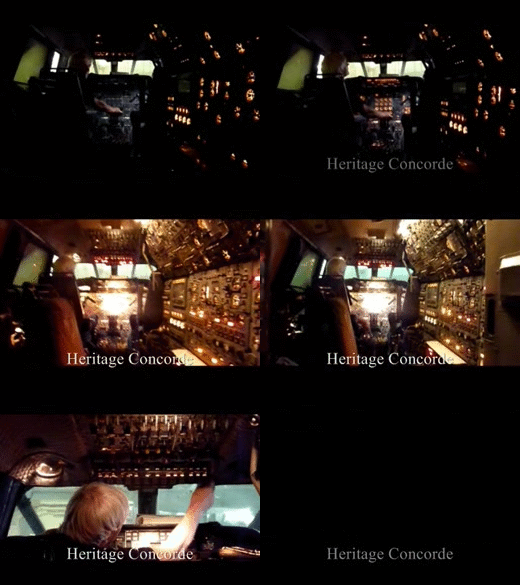
It’s a complicated little flight deck, but you have to remember that Concorde is a very complicated little aircraft. You have to try and imagine the design effort that went into all of these panels. Concorde’s flight deck will at first give you the impression of crowding, it is smaller than most cockpits and there is not quite full headroom Click on the links below for further reading and also to see how the Prototype & Pre-production flight decks differs from that of the Production flight deck.
- Description of the Flight Deck
- Flight Deck Floor, Wall & Ceiling Linings
FUEL SYSTEMS
The Concorde fuel system has three functions; to supply fuel to the engines, to control the position of the aircraft’s Centre of Gravity (CG) and to act as a heat sink to absorb kinetic heating from the structure and to dissipate heat generated by the air-conditioning and hydraulic systems. Click on the links below for further details.
- Development & General Description
- Approved Fuels /Additives & Fuel Tank Capacity
CONTROL SURFACES
m
mm
Concorde is controlled in pitch and roll by 6 elevons, and in yaw by 2 rudders. The pilots control column movements are the same for Concorde as in any other aircraft. Unlike other aircraft Concorde has no tail-plane and the elevons are placed along the trailing edge of the wing. The nose up and down movements, are controlled by these 6 elevons (mainly the inner pair). The middle and outer elevons pairs also act as ailerons. Click on the links below for further details.
- General Description of the Control Surfaces
- - Elevons and Rudders
- - Power Flying Control Unit (PFCU)
- - Roll, Pitch & Yaw
- - Trim Control
- - Artificial Feel
- - Mechanical Control Channel
- - Fly-By-Wire System
FLYING SYSTEMS
The complex systems that are installed in Concorde for flight and engine control, fuel supply and air conditioning and which carry out a number of other tasks including rising and lowering the landing gear, require hydraulic and electric power.
- - Concorde Green Hydraulic System – Description & Operation
- - Concorde Blue Hydraulic System – Description & Operation (COMING SOON)
- - Concorde Yellow Hydraulic System – Description & Operation (COMING SOON)
- - Gold Brazing on the Airframe Hydraulic System Pipe-work
- - Nose & Visor Hydraulic System
- - Chevron M2-V Concorde Hydraulic Fluid
- - Hydraulic Pipe Line Clamp Blocks
POWERPLANT
The flight development and certification of the Concorde powerplant was probably the most difficult in the whole Concorde flight-test programme. The BAC Technical Director, Dr Bill Strang, once stated that: ‘The powerlplant was the most persistent area of difficulty, requiring the highest level of sustained and dedicated effort by very talented people to solve the various problems’. This of course was very true, and all credit has to go to the design group, which contained some real wizards. Click on the links below for further details.
- Variable (Hinged buckets) Exhaust Nozzles
AUTOMATIC FLIGHT CONTROL SYSTEM (AFCS)
Concorde has an Automatic Flight Control System (AFCS), which in the 1970s, at the time when it was installed within the aircraft, was state of the art.
FUSELAGE DOORS & WINDOWS
Concorde has a series of Passenger Doors, Service Doors, Baggage Compartments & Miscellaneous Doors, this section also covers the Flight Deck Door. The external windows of Concorde must withstand a temperature variation of from approximately -50 deg C to approximately 117 deg C at the aircraft supersonic cruising speed. They are manufactured from the toughened glass, and are double-glazed with the exception of the flight deck windshield and visor panels. Click on the links below for further details.
- Description of the Fuselage Doors
- General Description of Concorde’s Windows
EMERGENCY PROCEDURES & EQUIPMENT
Oxygen Systems & Masks – Liferafts – Emergency Ditching & Crash Landing – Cabin, Flight Deck & Engine Fire – Rapid Depressurization – Emergency Descent – Low Hydraulic Pressure at the Flying Controls – Landing with Abnormal Landing Gear Configuration
- Emergency Evacuation and Equipment
CONCORDE PASSENGER CABIN EQUIPMENT & FURNISHINGS
This section deals with the aircraft furnishings that the Concorde passenger would expect to see and use during their time in the passenger cabin, and those hidden furnishings that would make their journey on the edge of space, both relaxing and comfortable.
- BA Passenger Seating 2001 – 2003
- BA Passenger Seating 1993 – 2001
- Galleys
- Carpets & Overhead Luggage Bins
- Toilets
- Passenger Compartment Wall & Ceiling Linings, including Window Blinds & Cabin Insulation
AIRCRAFT BAGGAGE COMPARTMENTS
On Concorde the baggage allowance was very low due to the small space allocated for baggage. This section covers the two baggage holds on the aircraft, the structure, access, lighting and the baggage retaining methods.
AIR CONDITIONING & VENTILATION SYSTEMS
The air conditioning system consists of four air conditioning groups supplying conditioned air to the cabin and flight compartment in order to provide an environment compatible with the comfort of passengers and crew.
- Air Conditioning Group Description
- Vapour Seal/Fuel Tank Interspaces Ventilation System
- Automatic Temperature Control System
THE CAA & DGAC CONCORDE AIRCRAFT MODIFICATIONS 2001
The background to and the required modifications carried out to the Concorde fleets following the Paris crash in 2000
- Description of the Modifications
Heritage Concorde is now on Facebook
JOIN THE HERITAGE CONCORDE FACEBOOK GROUP
Click on the link above to join in the discussion with former Concorde engineers and fans
© Heritage Concorde 2012-2013
Heritage Concorde gif pictures by Graham Cahill